
Add your average cycle length to the first day of your most recent period. For example, a 29-day average added to a September 3 start gives an estimated next start of October 2. A period calculator automates this calendar step; it cannot confirm when your next period will begin.
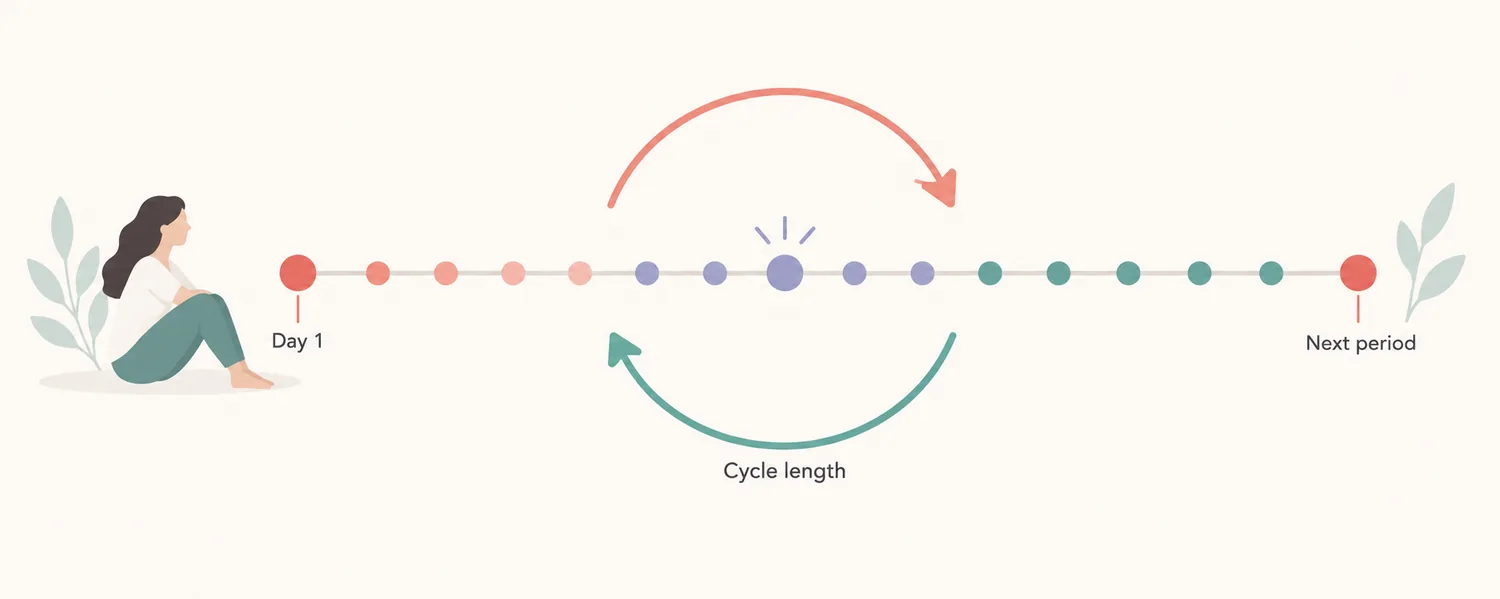
What a period calculator estimates
A period calculator is a calendar planning aid. It uses the first day of your most recent period and an average number of days between period starts to estimate a future date. The main output is the next expected period start. If the calculation is repeated for later months, each result is another projection based on the same average, not a confirmed event.
A menstrual cycle and a period are related but different measurements. Period length is the number of bleeding days. Cycle length is the number of days from the first day of one period to the first day of the next. If a period lasts five days, that does not mean the cycle is five days long. Mixing these numbers can move an estimate by several weeks.
Use its output as a date to plan around, then replace the estimate with the actual start date when you have it.
| Part | What it means | How it is used |
|---|---|---|
| Last period start | Day 1 of the most recent period | Anchors the calculation |
| Cycle length | Days between two period start dates | Moves the estimate forward |
| Period length | Days of bleeding in one period | Can estimate an end date, not the next start |
| Next period date | A calendar projection | Useful for planning, not a guarantee |
How to calculate your next period date
Add the cycle length as elapsed days from the first day of your last period. A 29-day cycle means the next start is 29 days later, not the 29th calendar day of the month.
If your last period began on September 3 and your average cycle is 29 days, the estimated next start is October 2. Record the actual date when it arrives and use that as the new starting point.
Estimated next start = last period start + average cycle length
- Write down the first day of normal bleeding for a period. Use the same definition each time so the dates are comparable.
- When the next period begins, count the days between the two start dates. Do not count from the day bleeding ended.
- Record several recent cycles if you can. A set of observations gives more context than relying on a single interval.
- Calculate an average from the cycle lengths you recorded, then enter that value with the latest actual start date.
- Review the forecast as an estimate. Replace it with the next actual date when your cycle starts.
The first day of one period is the anchor for cycle counting. The number of bleeding days is a separate value.
Choose a useful menstrual cycle length
A default value such as 28 days is only a starting example. It is not a rule that every person must follow. Your own recent cycle lengths are more relevant to a personal calendar estimate, although even a carefully calculated average cannot make the next date certain.
To find an average, add the lengths of the cycles you recorded and divide by the number of cycles. For example, cycle lengths of 27, 29, and 30 days total 86 days; divided by three, the average is about 28.7 days. A calculator that accepts only whole days may use 29 as a practical input. Keep the decimal and rounding choice in mind when comparing a forecast with an actual date.
If one interval looks very different, check the dates rather than silently discarding it. Note uncertainty; a clear record is more useful than a precise result built from uncertain inputs.
| Recorded cycle | Length | Use in the average |
|---|---|---|
| Cycle 1 | 27 days | Include if both start dates are known |
| Cycle 2 | 29 days | Include if both start dates are known |
| Cycle 3 | 30 days | Include if both start dates are known |
| Average | About 28.7 days | A whole-day tool may use 29 |
Read a period date range without false precision
If your recorded cycles vary, a single average can hide that variation. A date range can be easier to interpret, as long as it is clearly tied to the shortest and longest cycle lengths you entered. The range describes those inputs; it is not a statistical confidence interval and does not promise that a future period will fall inside it.
For example, if the last period started September 3 and the cycles you choose to use range from 26 to 32 days, the calendar arithmetic produces a possible start range from September 29 to October 5. That range is a planning aid. It does not explain why cycles differ or predict the exact date within the range.
When using a period cycle calculator, check whether it labels a date as an average estimate or a range. Those outputs answer slightly different questions. The average gives one central planning date; the range shows how the selected cycle lengths shift the calendar. Neither output should be presented as a medical assessment.
- Use a range when your inputs vary enough that one date would appear more certain than it is.
- Check the shortest and longest values before relying on the displayed dates.
- Recalculate after recording a new actual period start, rather than extending an old estimate indefinitely.
What a calendar prediction can and cannot tell you
A next period date calculator can answer a narrow question: what date follows when a past start date is combined with a chosen cycle length? It can help with general planning, such as noting a possible date before travel or adding a reminder to a personal calendar. It cannot measure what is happening in your body today.
Calendar arithmetic also cannot confirm ovulation or identify a fertile window for an individual cycle. Those dates depend on assumptions about timing, and real timing can shift. Do not use a period prediction to prevent pregnancy or to decide that unprotected sex is safe. Use a reliable contraceptive method and seek qualified medical advice for pregnancy-related questions.
A period arriving later or earlier than an estimate does not reveal the cause. A calendar tool cannot diagnose pregnancy, a hormonal condition, infertility, or another health issue. If you are concerned about a possible pregnancy, use an appropriate test and follow its instructions; if you have worrying symptoms or repeated major changes, speak with a qualified healthcare professional.
Keep the result labeled as estimated and avoid treating one forecast as proof that something is wrong or that everything is fine.
Keep a simple record that improves your estimates
A paper calendar, a private note, or a tracking app can all hold the dates needed for a menstrual cycle calculator. Record the first day of each period consistently. If you want to compare period length as well, record the last bleeding day separately so it does not get mixed up with cycle length.
When an estimate differs from reality, record the actual date, check for input errors, and decide whether the average still reflects the pattern you want to use.
If you choose a digital tracker, review what information it stores and whether it syncs to an account. The basic calculator on this site performs date calculations in your browser and does not require an account. The Privacy Policy explains other site technologies, including analytics and advertising, so do not treat the calculation itself as a statement about every service used by the site.
Further reading
For medically reviewed background and additional context about menstrual cycles, consult a public health source or a qualified clinician. The calendar method described here is arithmetic, not a clinical assessment.
- Office on Women's Health: Your menstrual cycleA U.S. Department of Health and Human Services resource about the menstrual cycle.
Period calculator questions
How does a period calculator estimate my next period?
It adds your average cycle length to the first day of your last period. The result is a calendar estimate based on the values you entered, not a confirmed date.
What date counts as day 1 of my cycle?
Use the first day of your period as you consistently define it. Cycle length is measured from that start date to the first day of the next period, not from the day bleeding ends.
Is a 28-day cycle required for a period calculator?
No. Twenty-eight days is a common example value, not a requirement. Use a recent personal average when you have one, and remember that the next cycle may still differ.
How can I calculate my average cycle length?
Record the days between successive period start dates, add those cycle lengths, and divide by how many cycles you recorded. Check the dates before using the average as an input.
Can I calculate my next period if my cycles vary?
You can use a range based on shorter and longer cycle lengths you have observed. That range reflects your inputs; it does not guarantee the next start date will fall within it.
Can a period calculator tell me why my period is late?
No. A date estimate cannot identify the reason timing changed or diagnose a health condition. If you are worried about pregnancy, symptoms, or repeated changes, speak with a qualified healthcare professional.
Can a period calculator predict ovulation accurately?
It may show a general calendar estimate, but it cannot confirm ovulation or measure your individual timing. Do not use a calendar estimate as contraception.
What should I do when the estimate does not match my period?
Record the actual start date, check the earlier inputs, and recalculate with updated dates. If the change concerns you or happens repeatedly, ask a qualified healthcare professional for advice.